
Coronado Voter Lookup Fields
The San Diego County Registrar of Voters Voter Information Lookup is the front door for a Coronado voter who wants to check registration details tied to a current address. The form is built for self-service verification. It does not let the public browse voter registration records by last name, scan a Coronado street, or pull a list of neighbors. A useful search starts with the exact residence facts the county uses to match a voter record.
| Lookup field | Input type | Required | Coronado search note |
|---|---|---|---|
| Party preference selector | Selector/dropdown | Yes, visible | Appears first; the captured official text did not list every option. |
| House number | Text | Yes | Use the street number for the residence. |
| Birth date | Date | Yes | Used to authenticate the match. |
| Pre-direction | Dropdown/text | No | Direction before the street name, when the address has one. |
| Street name | Text | Yes | Enter the street name without turning the search into a name browse. |
| Street type | Dropdown/text | No | Avenue, Street, and similar address types fit here. |
| Post-direction | Dropdown/text | No | Direction after the street name, if used. |
| ZIP code | Text | Yes | Required for the address match. |
| Submit/Search | Button | Not applicable | Runs the lookup after the required fields are complete. |
That field design is the key local point. Coronado voter status is not exposed like a phone book. The online lookup is narrow, and the fuller voter file runs through a separate application process with California use limits.
The county screenshot source is the San Diego County Voter Information Lookup.
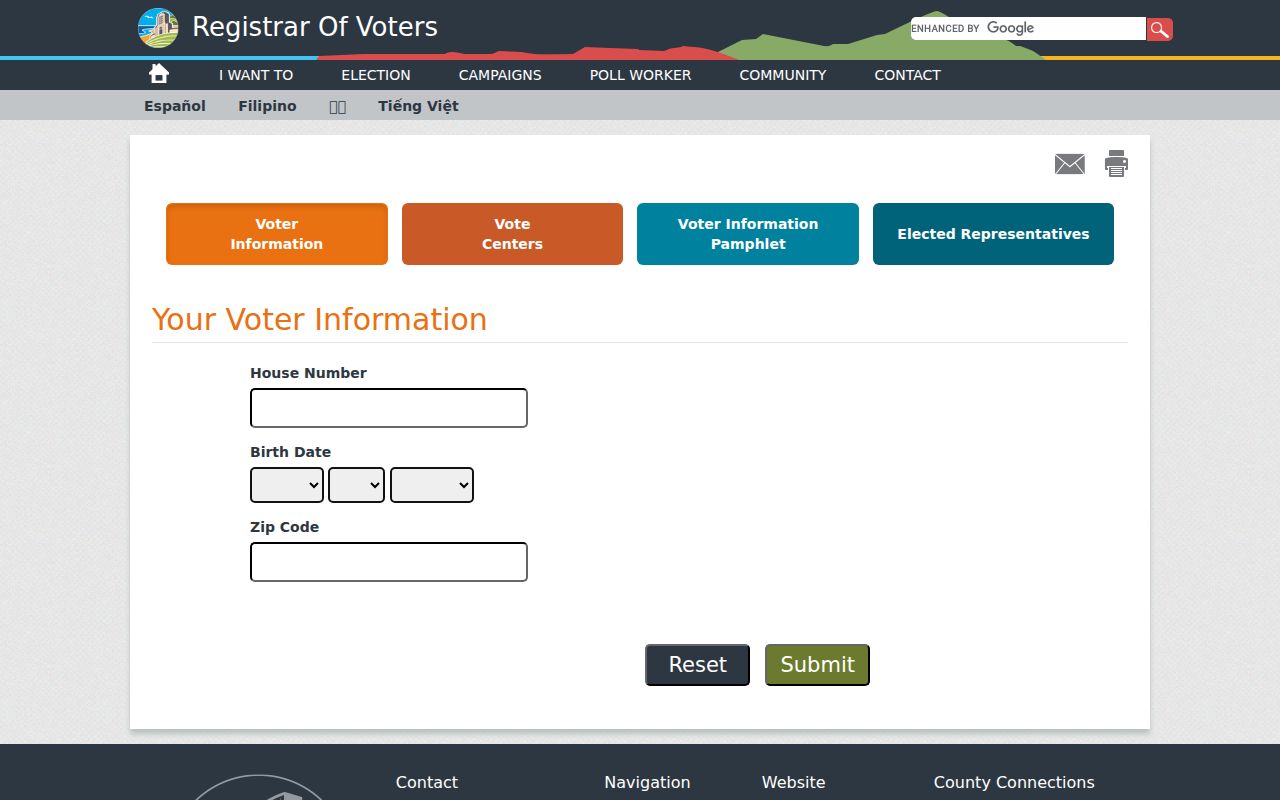
The screenshot shows why a Coronado voter registration search depends on address and birth-date inputs, not public name browsing.
Coronado Voter Registration Limits
The strongest myth to drop is the idea that the San Diego County lookup is a public resident directory. It is not. The lookup asks for party preference, house number, birth date, street name, street type where needed, post-direction where needed, and ZIP code. Those fields are meant to confirm a known voter, not discover unknown people.
For Coronado, that matters because voter rolls can be useful in civic, journalistic, scholarly, and political work, but the public tool does not open the roll by name. If the lookup does not return what a voter expects, the next step is the Registrar of Voters, not a broader web search. For general public-record access rules outside the voter-file process, the California Public Records Act framing is covered on the Coronado public records page.
Note: The voter lookup can confirm a match, but it is not proof that every voter-file field is public.
California Voter Records Inventory
California voter records can contain more detail than the county lookup displays. State access regulations describe fields such as registration county, unique registration ID, name, residential address, mailing address, phone, email, language preference, date of birth, gender, party preference, registration status, precinct, place of birth, voting assistance request status, permanent vote-by-mail status, county voter ID, and participation history.
Participation history has a narrow meaning. It can show that a voter participated in an election. It never shows which candidate, measure, or party choice appeared on the ballot. For Coronado voter registration records, that difference is crucial: a record may document registration facts and election participation, but ballot secrecy remains intact.
| Name | Available in voter data for approved uses under California rules. |
|---|---|
| Residential address | Not routine public browsing material; released only for permitted uses and subject to protected-voter exclusions. |
| Mailing address | May appear in the voter file for approved uses, with protected voters excluded or redacted. |
| Party preference | California registers party preference, and it can be included in voter data. |
| Status and method | Status, status date, registration method, and status reason can be part of the file. |
| Precinct and districts | Included in voter or election data where the approved request supports it. |
| Date of birth | Included in voter data but protected from routine public release. |
| Phone and email | Confidential from routine access but may be included for approved uses. |
| Voting participation | Shows elections in which the voter participated, never ballot choices. |
Confidential Coronado Voter Records
California separates voter-registration access from routine public disclosure. Government Code § 7924.000 makes specified voter-registration information confidential except as provided by Elections Code § 2194. The protected fields include voter-registration affidavits, driver license or state ID numbers, Social Security number data, signatures, and contact fields such as phone and email in the contexts the statutes protect.
Signatures have a special rule. A signature may be viewed for comparison in the allowed setting, but it may not be copied. A Coronado voter-file request should also expect confidential-voter exclusions before any data is produced.
Confidential by law. Coronado voter registration records are filtered by Gov. Code § 7924.000 and Elec. Code § 2194, with protected addresses, ID numbers, signatures, birth data, phone, and email kept out of routine public access.
Requesting San Diego Voter Data
The full voter-file path for Coronado runs through the San Diego County Voter Registration Data Application linked from the Registrar of Voters forms page, not through the lookup page. The application asks for applicant name, organization or title if one applies, email, phone, residence or business address, mailing address if different, beneficiary information when the request benefits another person or entity, the requested product, intended use, and security practices.
- Choose a permitted use category on the county application. The listed categories include election, political, scholarly, journalistic, record review, and vendor uses; governmental use does not require the same application.
- Identify the product requested, such as the one-time San Diego County registered voter file, a vote-by-mail activity or status report, or specific voter records.
- Initial the agreement terms, including approved-purpose use, secure maintenance, breach notice, and acknowledgement of misdemeanor misuse rules.
- Sign with an original wet signature and attach a clear copy of a current driver license, state ID, or current photo ID.
- Mail the packet to San Diego County Registrar of Voters, 5600 Overland Ave., San Diego, CA 92123. Email and fax submission are not accepted.
The county forms screenshot source is the San Diego County Registrar of Voters forms page.
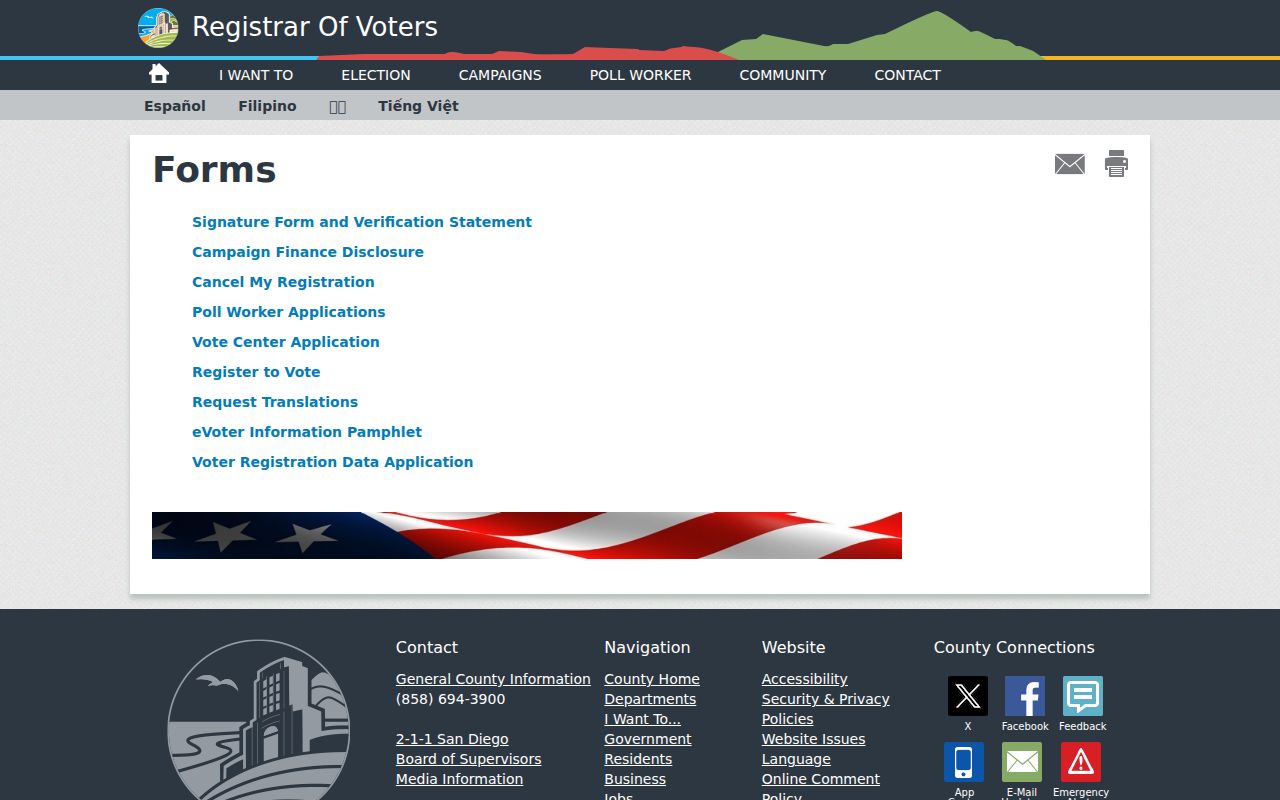
The forms page is the practical bridge between the public lookup and the written application required for voter data.
Coronado Voter Data Fees
The San Diego County application gives the fee and delivery limits for voter registration data. A one-time San Diego County registered voter file costs $75. Vote-by-mail voting activity status report option 1 costs $285, and specialized vote-by-mail information option 2 costs $216. Specific voter records, up to 10 per application, are billed at $98 per hour, prorated under one hour, with an estimate before the search. Printed list copy fees may be extra.
The delivery format is also fixed. The county provides tab-delimited text only. Requesters are responsible for import, export, sorting, and formatting after delivery, and the Registrar of Voters does not provide technical support for those tasks. That makes the application more like a controlled data release than a simple voter lookup.
Permitted Voter Roll Uses
The California Secretary of State access rules allow voter-registration information for election, scholarly, journalistic, political, governmental, record-review, and vendor purposes. They bar personal, private, and commercial use outside the permitted categories, non-permitted solicitation or surveys, harassment, and transfer of voter information outside the United States.
Elections Code § 2188 requires the applicant's name, residence or business address, phone number, ID number, the specific information requested, the intended use, and the identity and contact information for any person or entity on whose behalf the request is made. Applications are retained for five years. Elections Code § 2188.5 also bans sending requested voter information outside the United States or making it electronically available to people outside the United States.
Use restriction. Misusing Coronado voter records for personal, private, commercial, harassing, or foreign-transfer purposes can trigger the application's misdemeanor acknowledgement and California statutory penalties.
Protected Voters After AB 1392
Confidential voters are excluded from voter lists, rosters, and indexes before data reaches the requester. California recognizes several paths into that protected status: Safe at Home confidential registration under Elections Code § 2166.5, court-ordered confidentiality under § 2166, public-safety-officer confidentiality under § 2166.7, and elected-official or candidate confidentiality added by AB 1392.
AB 1392 was chaptered on October 3, 2025, and the Secretary of State's December 12, 2025 guidance told county elections officials to exclude confidential voters from lists, rosters, and indexes. For a Coronado voter registration records request, that means an approved use and paid file still will not expose voters covered by those protections.
Note: Safe at Home supplies a substitute address and confidential voter registration, but it does not erase every older public record.
San Diego List Maintenance
San Diego County voter records move through active, inactive, pending, and cancelled categories. Inactive status can result from returned mail or postal data that points to a possible move. An inactive voter is mailed a forwardable confirmation card, remains eligible, but receives no election mail and is not counted in turnout tallies, signature-gathering lists, or campaign lists.
A voter can restore status by voting, signing a petition, or contacting the office. Removal can follow after failure to confirm or update information and no voting in two consecutive federal elections. The Registrar of Voters uses agency cross-checks, voter updates, death records and family notice, court felony or cancellation information, monthly USPS National Change of Address checks, daily DMV change-of-address checks, daily statewide duplicate checks, and returned mail.
Historical Coronado Voter Records
Modern Coronado voter rolls are controlled by current California and San Diego County rules, but older voter sources can support family history and civic-history research. FamilySearch's California Great Registers collection covers county clerk voting registers from 1866 through 1910 for most California counties. Coronado incorporated in 1890, so late nineteenth-century and early twentieth-century San Diego County registers may overlap with early Coronado residents.
The San Diego History Center archives also hold election-related material. Its MS 269 San Diego Election Collection includes election results, poll lists or names of voters, sample ballots, party tickets, and campaign literature. The California State Archives adds a broader political and administrative record path when county-level historical voter rolls are not enough.